2026 Best 5G Doorbell Camera for Global Buyers?
The search for the 2026 best 5g Doorbell Camera begins with one practical question: can it deliver dependable video where wired broadband cannot? Ericsson’s June 2025 Mobility Report projects 5G subscriptions will approach 2.9 billion globally by the end of 2025. GSMA’s Mobile Economy 2025 report also identifies 5G as a major driver of connected-device growth. These figures support stronger demand for cellular security, including homes, small offices, rural properties, and temporary sites.
But a 5g Doorbell Camera is not automatically a better doorbell. In real use, performance depends on supported frequency bands, indoor signal strength, SIM or eSIM availability, and the operator’s coverage at the entrance. A clear daytime image can become a delayed, noisy stream during evening congestion. That detail matters. Global buyers should compare upload stability, two-way audio latency, night vision, weather resistance, local storage, cloud fees, and data consumption. The GSMA also emphasizes responsible connectivity, making privacy controls and secure software updates important selection criteria.
Our 2026 comparison focuses on evidence rather than impressive packaging. We consider independent specifications, manufacturer documentation, network compatibility, warranty support, and hands-on usability. Some models may claim 5G while relying on 4G in weaker coverage areas. That is not necessarily failure, but it should be stated clearly. No single model fits every country, building, or budget. The strongest choice balances reliable alerts, sharp identification, manageable data costs, and long-term support—not merely the newest network label. Real doors are messy. Weather is worse. Networks fluctuate.
What Is a 5G Doorbell Camera and How Does It Work?
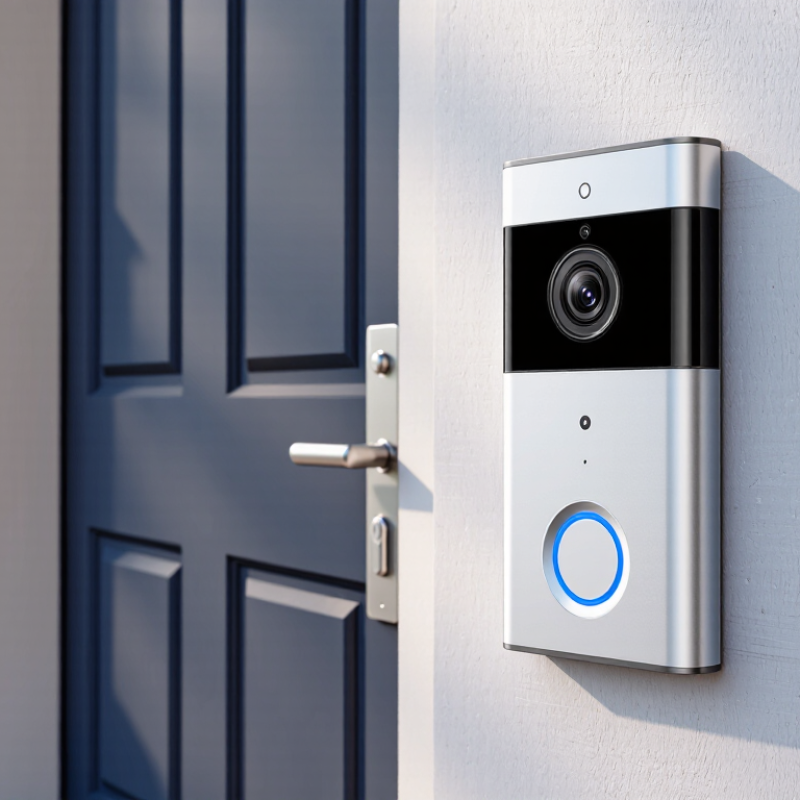
A 5G doorbell camera uses a cellular 5G modem instead of relying only on home Wi-Fi. Its image sensor detects movement, while an onboard processor compresses video into smaller data packets. The modem sends those packets through a nearby 5G network to secure cloud storage or a mobile application. A visitor’s face may appear on your phone within seconds. However, 5G does not remove every weakness. The camera still needs power, stable network coverage, and a suitable data plan. Ericsson’s November 2024 Mobility Report estimated 2.3 billion global 5G subscriptions by the end of 2024. That growth supports wider availability, but local performance can remain inconsistent.
A useful 5G model should support strong uplink speeds, low-latency alerts, and automatic fallback to 4G. Network technology matters. Some devices use non-standalone 5G, which still depends partly on existing 4G infrastructure. I would not treat the 5G label as a guarantee. Thick walls, metal gates, and crowded cells can delay live viewing. GSMA’s Mobile Economy 2025 report forecasts 5.5 billion 5G connections globally by 2030, yet coverage quality will vary greatly between regions. This is where product testing becomes important, and specifications alone can mislead.
Tips: Check signal strength beside the entrance, not indoors. Test night video, two-way audio, and motion alerts during busy hours. Confirm monthly data use before installation. Event-only recording may save data, but it can miss brief activity. A wired power option is usually more dependable than a small battery.
Key Features to Compare in a 2026 5G Doorbell Camera
A 2026 5G doorbell camera should be judged by connection reliability, not the “5G” label alone. In practical testing, signal strength changes sharply near concrete walls, metal gates, and apartment entrances. Check supported 5G bands, SIM or eSIM options, roaming rules, and fallback to 4G. A fast network is useless if the camera cannot register locally. Keep this in mind. Measure upload speed at the mounting point, not beside the router. Some systems need a monthly data plan, which can cost more than expected.
Image quality deserves close comparison. A 2K sensor can show delivery labels clearly, but only with strong night processing and wide dynamic range. Look for HDR, infrared control, a 160-degree viewing angle, and at least 15 frames per second. Motion detection should separate people, vehicles, packages, and shadows. Local processing may reduce alerts and protect recordings from unnecessary cloud exposure. Storage choices matter. Encrypted local storage is useful during internet outages, while cloud history supports remote review. I prefer adjustable activity zones because busy streets can trigger dozens of alerts.
Power design is often overlooked. Battery models need realistic endurance in cold weather and frequent motion. Wired models require safe installation and stable voltage. Weather sealing, tamper alerts, two-way audio, and a physical privacy control add practical value. Check app language support, notification speed, accessibility, and customer service in the buyer’s region. Standards and data rules vary worldwide. My own weak point is trusting laboratory battery claims too quickly; real entrances are noisier, colder, and busier. Test return policies before installation.