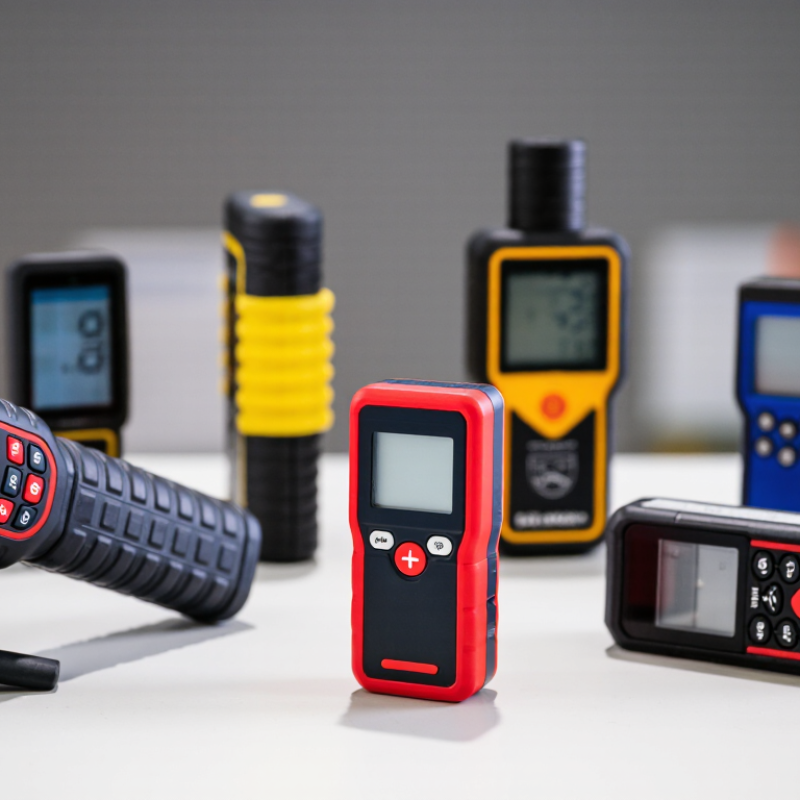
| Laser Distance Meter | Point-to-point distance, area, volume, indirect height and continuous distance | Approximately 0.05–200 m for general handheld models; longer ranges are available for specialized systems | About ±1.5–3 mm under suitable indoor conditions | Red: commonly around 630–680 nm; green: commonly around 510–540 nm | Construction, interior measurement, facility maintenance, surveying preparation and property inspection | Maximum range, target visibility, display readability, measurement mode, data storage, tripod compatibility and calibration documentation | Many professional handheld models provide dust and splash resistance; operating temperature is commonly around −10°C to 50°C |
| Laser Level | Horizontal, vertical, cross-line, multi-line or rotary reference planes | Visible working range commonly 10–30 m; up to approximately 50–100 m with a compatible detector | Typically around ±2–5 mm at 10 m for compact self-leveling units | Red: commonly around 630–680 nm; green: commonly around 510–540 nm | Wall alignment, ceiling installation, flooring, masonry, cabinet installation and general construction | Self-leveling range, line visibility, number of planes, detector compatibility, battery life and drop resistance | Professional models may include IP54 or higher protection; self-leveling compensation is often approximately ±3°–5° |
| Laser Power Meter | Average optical power emitted by a continuous-wave or modulated laser | Sensor-dependent; commonly from microwatt or milliwatt levels to watts, with higher-power heads available | Often approximately ±3–5% of reading, depending on detector, wavelength and calibration | Common detector coverage includes ultraviolet, visible and near-infrared bands; exact range depends on the sensor head | Laser development, laboratory testing, optical alignment, manufacturing quality control and safety verification | Detector type, maximum power density, wavelength correction, response time, cooling method, analog output and calibration traceability | Use only within the specified power density and wavelength limits; thermal sensors are often used for higher-power measurements |
| Laser Energy Meter | Pulse energy, single-shot energy and pulse-to-pulse stability | Detector-dependent; commonly from microjoules or millijoules to joules, with specialized systems covering higher energies | Frequently around ±3–5% of reading under calibrated conditions | Available detector bands may cover ultraviolet, visible, near-infrared and infrared wavelengths | Q-switched lasers, pulsed laser processing, medical laser testing, research laboratories and optical safety checks | Maximum pulse energy, repetition rate, pulse width, aperture size, wavelength response, damage threshold and data logging | Detector selection must match pulse duration, repetition frequency, beam diameter and maximum fluence |
| Laser Wavelength Meter | Absolute or relative optical wavelength and wavelength drift | Usually designed for a specified spectral band, such as visible, near-infrared or telecom wavelengths | High-resolution instruments can provide picometer- or sub-picometer-level resolution, depending on technology and range | Common product families cover approximately 400–1,100 nm or selected near-infrared telecom bands | Diode laser characterization, spectroscopy, fiber-optic testing, communications and research | Spectral range, wavelength accuracy, resolution, input power, free-space or fiber input, warm-up time and calibration method | Requires stable optical coupling and suitable input power; ambient temperature stability can affect precision |
| Laser Beam Profiler | Beam diameter, beam shape, centroid, ellipticity, uniformity and intensity distribution | Sensor area and measurable beam size vary widely; systems may support sub-millimeter to several-centimeter beams | Depends on sensor pixel size, optical attenuation, software algorithms and calibration | Common versions support visible and near-infrared wavelengths; ultraviolet and infrared configurations are also available | Optical alignment, beam quality analysis, laser manufacturing, research and system integration | Sensor format, pixel resolution, damage threshold, attenuation options, frame rate, software functions and wavelength response | Neutral-density attenuation or beam expansion may be required for high-power or oversized beams |
| Laser Interferometer | Highly precise displacement, straightness, flatness, vibration or surface movement | Measurement distance depends on the optical configuration; systems may support short machine-tool axes to long-path metrology | Can achieve nanometer-scale resolution in controlled environments; overall accuracy depends on environmental compensation | Commonly uses stabilized visible or near-infrared laser sources | Coordinate measuring machines, precision stages, machine-tool calibration, semiconductor equipment and scientific research | Environmental compensation, air temperature and pressure sensors, vibration isolation, optical path stability and software compatibility | Best performance requires controlled temperature, limited vibration and clean, stable optical alignment |
| Time-of-Flight Laser Scanner | Three-dimensional distance points, range, position and spatial geometry | Common terrestrial systems cover tens to several hundred meters; compact systems generally provide shorter ranges | Typical point-distance accuracy ranges from a few millimeters to centimeters, depending on range and system class | Commonly uses near-infrared laser wavelengths | Building documentation, infrastructure inspection, terrain mapping, industrial measurement and digital twin creation | Scanning speed, point density, field of view, range, outdoor performance, registration workflow and data export formats | Reflectivity, sunlight, rain, dust and atmospheric conditions can affect range and point quality |
| Laser Doppler Vibrometer | Non-contact surface velocity, displacement and vibration frequency | Frequency and displacement ranges depend on optical head and electronics; systems are selected for low-frequency motion or high-frequency vibration | High sensitivity is possible, but performance depends strongly on surface reflectivity, working distance and bandwidth | Commonly uses visible or near-infrared laser wavelengths | Rotating machinery, electronics, acoustic testing, structural analysis and research laboratories | Frequency bandwidth, working distance, target reflectivity, measurement spot size, velocity range and signal processing capability | Requires a stable optical path and adequate return signal; reflective tape or surface treatment may be needed for dark targets |