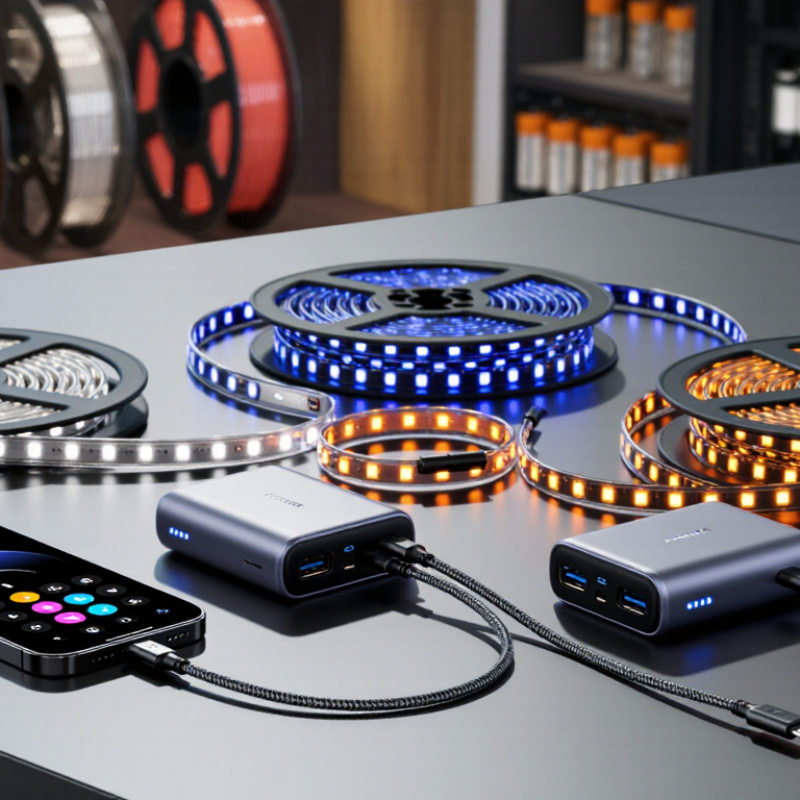
| LED Technology | SMD LED strip with evenly spaced diodes; COB construction for a continuous dot-free appearance | Determines light uniformity, appearance and heat distribution | Request LED density, strip construction details and a powered sample |
| Operating Voltage | 5 V USB for compact use; 12 V or 24 V systems for longer or higher-output installations | Must match the battery pack, adapter, controller and strip design | Check the product label, connector polarity and measured input voltage |
| Power Consumption | Compare watts per metre and total system wattage; include controller and conversion losses | Controls battery size, heat generation, runtime and operating cost | Request a rated watts-per-metre value and verify it under normal operation |
| Brightness | Specify measured lumens per metre or illuminance at a defined distance instead of relying only on LED count | LED quantity alone does not accurately indicate useful light output | Request photometric data and compare samples using the same power and diffuser conditions |
| Color Temperature | Warm white: approximately 2700–3000 K; neutral white: approximately 3500–4500 K; cool white: approximately 5000–6500 K | Affects atmosphere, visibility and color perception | Confirm the nominal CCT and inspect a powered sample for visual consistency |
| Color Rendering Index | CRI 80 or higher for general lighting; CRI 90 or higher for displays, photography and color-sensitive work | Higher CRI generally produces more natural-looking colors | Request a test report showing Ra and, where relevant, R9 performance |
| Ingress Protection | IP20 for dry indoor use; IP65 for dust protection and water jets; IP67 for temporary immersion when properly sealed | Protects the strip from dust and moisture in the intended environment | Verify the complete assembly rating, including connectors, controller and battery enclosure |
| Battery and Runtime | Specify battery chemistry, capacity in Wh, charging method and runtime at a stated brightness level | Runtime changes significantly with brightness, strip length and battery age | Use the formula: approximate runtime in hours = battery watt-hours ÷ system watts |
| Charging Interface | USB-C is preferred for modern portable products; confirm input rating and charging protection | Improves compatibility, charging convenience and replacement options | Check charging voltage, current, cable type and overcharge protection documentation |
| Control Method | Inline switch, remote control, Bluetooth or app control; dimming should be smooth and flicker-free | Determines usability, installation flexibility and user experience | Test pairing, control range, dimming steps and recovery after power interruption |
| Cutting and Connection | Cut only at marked cut points; confirm cut interval, connector type and maximum continuous length | Incorrect cutting or excessive length can cause open circuits, voltage drop or uneven brightness | Review the installation guide and test the shortest and longest intended configurations |
| Flexibility and Mounting | Flexible PCB or silicone-jacket construction with suitable clips, channels or adhesive backing | Affects installation reliability, bend radius and service life | Check the minimum bend radius, surface compatibility and adhesive performance after cleaning |
| Thermal Management | Use an aluminium profile or heat-conductive mounting surface for higher-output strips | Excess heat accelerates LED depreciation and can shorten component life | Measure surface temperature during a continuous operating test |
| Safety and Compliance | Require applicable electrical, battery, electromagnetic compatibility and material documentation for the destination market | Supports legal sale, safer operation and smoother customs clearance | Request current test reports, declarations, battery transport documents and product labels |
| Quality and Supply Capability | Use documented tolerances for CCT, brightness, battery capacity, color consistency and defect rate | Reduces variation between samples, production batches and replacement units | Approve a golden sample, define acceptance criteria and use pre-shipment inspection for volume orders |