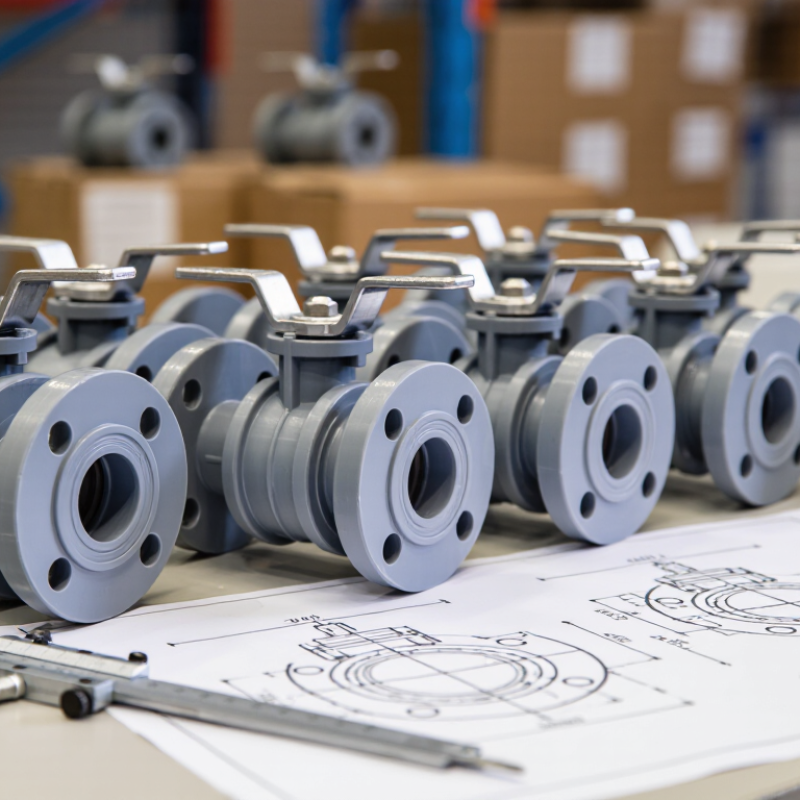
| Valve Material | Unplasticized polyvinyl chloride (PVC-U) | Rigid thermoplastic body, ball, end connectors, and union components. Sealing parts are commonly made from elastomers such as EPDM or PTFE, depending on the design. | Provides a lightweight, corrosion-resistant flow-control solution for many water and chemical service conditions. | Confirm the PVC-U compound, seal material, chemical compatibility, and applicable product standard before ordering. |
| Valve Configuration | Two-way, full-port or reduced-port; one-piece, two-piece, or three-piece construction | A spherical ball with a drilled passage rotates inside the valve body. Union-style designs allow easier removal from a pipe system. | Allows the valve to isolate or restore flow without removing the valve from the pipeline. | Choose full-port construction where lower flow restriction is important; choose a union design where maintenance access is required. |
| Operating Principle | Quarter-turn operation | The stem rotates the ball approximately 90 degrees between the open and closed positions. | Provides fast shutoff and clear visual positioning. The handle is generally parallel to the pipeline when open. | Check operating torque, handle clearance, stop design, and compatibility with manual or automated actuation. |
| Nominal Size Range | Commonly DN15 to DN100; larger sizes are available in selected product ranges | Nominal diameter is normally specified according to the connected piping system and the valve manufacturer’s dimensional series. | Matches the valve opening to the required flow capacity and pipe size. | Verify DN/NPS designation, outside diameter, face-to-face dimensions, and installation space. |
| Connection Methods | Solvent-cement socket, threaded, flanged, or union connection | Socket ends are joined using suitable PVC solvent cement. Threaded and flanged ends are used where dismantling or equipment connection is needed. | Creates a sealed connection between the valve and the piping network. | Confirm pipe standard, socket dimensions, thread type, flange drilling, gasket requirements, and joining procedure. |
| Pressure Capability | Often rated around PN10 to PN16 at reference temperature, depending on size and design | Allowable pressure is affected by valve size, temperature, material formulation, end connection, and the applicable rating system. | Defines the maximum permitted working pressure for safe service. | Do not use a nominal pressure value alone. Request the pressure-temperature curve and test documentation for the exact model. |
| Temperature Range | Commonly approximately 0°C to 60°C for water service | PVC-U becomes less pressure-capable as temperature increases. The actual limit depends on the body, seals, pressure, and manufacturer’s design. | Determines whether the valve is suitable for the process temperature. | For hot water or elevated-temperature service, verify derating data; PVC-U is generally not selected for high-temperature steam service. |
| Chemical Resistance | Good resistance to many acids, alkalis, salts, and aqueous chemicals | Resistance varies with concentration, temperature, exposure time, pressure, and the exact chemical formulation. | Reduces the risk of corrosion in compatible chemical-handling systems. | Request a chemical compatibility assessment for concentrated oxidizers, solvents, hydrocarbons, and unusual process fluids. |
| Flow Control Performance | Low-to-moderate pressure loss when fully open; flow coefficient depends on port and size | A full-port ball passage is close to the internal pipe diameter, while reduced-port designs create a smaller flow area. | Provides efficient on/off isolation and can support basic throttling, although continuous throttling may accelerate seat and ball wear. | Use a flow coefficient, pressure-drop, or sizing chart when selecting a valve for a specific flow rate. |
| Sealing System | Ball seats and stem seals commonly use PTFE, EPDM, or other application-specific elastomers | Seats seal the rotating ball, while stem seals limit leakage around the operating shaft. | Maintains internal shutoff and reduces external leakage during operation. | Check seat material, seal grade, shutoff class, replacement availability, and compatibility with the medium. |
| Electrical Properties | Nonconductive and electrically insulating compared with metallic valves | PVC-U does not provide the same electrical continuity as metal piping components. | Can be useful where electrical insulation and resistance to galvanic corrosion are desirable. | Do not rely on the valve for grounding or bonding. Follow the site’s electrical and piping safety requirements. |
| Installation Method | Lightweight, hand-installed, and suitable for plastic piping systems | Installation normally requires proper pipe preparation, alignment, solvent-cement technique, curing time, and support. | Reduces handling effort and can simplify installation compared with heavier metallic valve assemblies. | Evaluate installer training, joining instructions, curing requirements, pipe support, and access for maintenance. |
| Automation Options | Manual handle, electric actuator, or pneumatic actuator | The valve stem can be coupled to an actuator when automated isolation or remote operation is needed. | Enables timed, remote, or process-controlled opening and closing. | Check actuator torque, fail-safe position, cycle frequency, control voltage or air pressure, and mounting interface. |
| Typical Standards | ISO 1452, EN 1452, ASTM D1784, ASTM D2466, ISO 16135, and relevant local requirements | Different standards address PVC-U compounds, piping systems, fittings, or industrial thermoplastic valve requirements. | Provides a basis for material identification, dimensions, testing, and performance verification. | Confirm which standard applies to the complete valve assembly, not only to the pipe or raw material. |
| Water Treatment Use | Suitable for many cold-water, filtration, irrigation, and water-treatment lines | PVC-U offers corrosion resistance and a smooth internal surface in compatible water systems. | Controls flow to filters, pumps, tanks, dosing systems, and distribution branches. | Verify potable-water approval where drinking-water contact is involved and check disinfectant compatibility. |
| Chemical Processing Use | Suitable for selected low- to moderate-temperature chemical services | The valve’s body, seats, seals, and connection method must all be compatible with the process fluid. | Provides isolation for chemical dosing, drainage, transfer, and treatment circuits. | Obtain written compatibility confirmation for the chemical concentration, temperature, pressure, and exposure conditions. |
| Aquaculture and Irrigation Use | Commonly used in non-metallic water distribution and irrigation networks | Lightweight construction and resistance to many water-treatment chemicals support outdoor and agricultural installations. | Isolates zones, tanks, pumps, filters, and branch lines. | Consider ultraviolet exposure, freezing conditions, impact protection, drainage, and seasonal maintenance. |
| Quality Documentation | Product datasheet, dimensional drawing, pressure test record, material information, and installation instructions | Technical documentation should identify the valve model, size, material, seals, pressure rating, temperature limits, and connection standard. | Supports correct selection, traceability, installation, and maintenance. | When evaluating suppliers, request batch traceability, inspection records, warranty terms, spare-part information, and sample approval procedures. |
| Primary Advantages | Corrosion resistance, low weight, easy handling, low maintenance, and smooth internal surfaces | The thermoplastic body does not rust and generally requires no painting or internal corrosion coating. | Can lower installation effort and maintenance requirements in suitable services. | Balance these benefits against temperature limits, impact sensitivity, pressure derating, and chemical compatibility. |
| Main Limitations | Temperature sensitivity, impact vulnerability, pressure derating, and limited compatibility with some solvents and hydrocarbons | Mechanical and pressure performance changes with temperature and service conditions. | Defines when another thermoplastic or a metallic valve may be more appropriate. | Supplier selection should include application review, installation guidance, replacement support, and compliance documentation. |