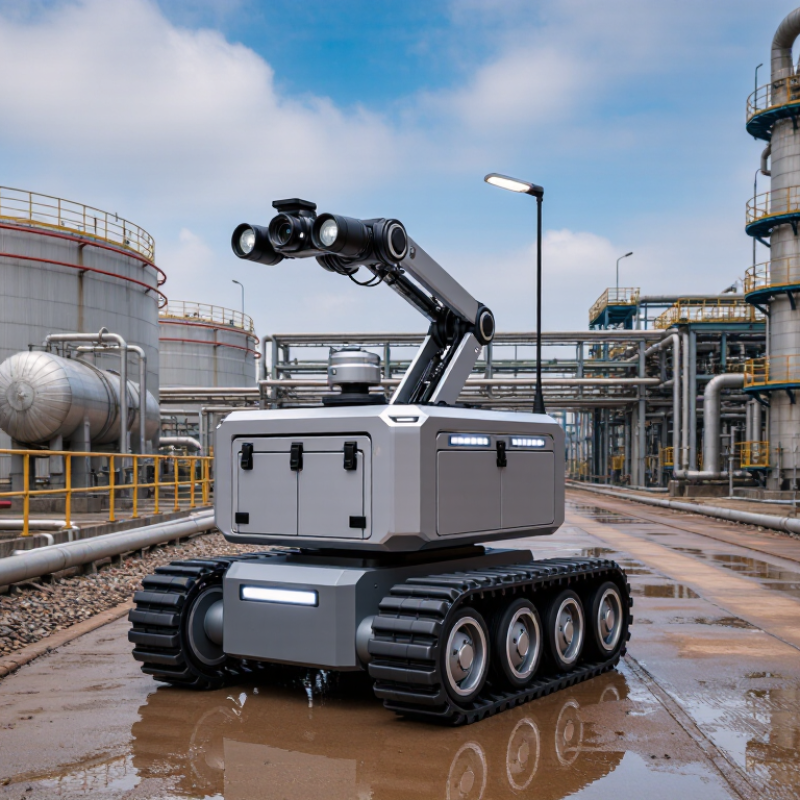
| Tracked Inspection Robot | Oil refineries, gas processing plants, chemical plants, tank farms | Zone 1 or Zone 2, subject to the certified configuration | Strong traction on concrete, grating, uneven floors, and moderate slopes | Approximately 10–50 kg, depending on chassis and payload module | Approximately 2–8 hours under normal inspection loads | Sealed electrical enclosure, intrinsically safe circuits or certified flameproof enclosure, static-control measures | Visible-light and thermal imaging, gas detection, acoustic leak detection, pressure-gauge reading | The site requires a balanced platform for routine patrols and uneven industrial terrain |
| Wheeled Explosion-Proof Patrol Robot | Indoor process areas, compressor stations, pumping stations, warehouses | Zone 2 applications and other areas approved by the relevant certification | Fast movement on smooth floors; less suitable for loose gravel, deep mud, and steps | Approximately 5–30 kg | Approximately 4–10 hours, depending on speed and sensor load | Low-spark drive design, protected battery compartment, sealed connectors, emergency stop system | Routine visual inspection, thermal screening, gas concentration measurement, video recording | Long patrol distance and low operating cost are more important than obstacle climbing |
| Quadruped Explosion-Proof Robot | Complex process units, pipe racks, construction areas, outdoor energy facilities | Potentially Zone 1 or Zone 2 only when the complete system is certified for that zone | Negotiates steps, thresholds, grating, slopes, and irregular ground better than most wheeled platforms | Usually approximately 5–20 kg | Approximately 1.5–4 hours in continuous inspection operation | Certified power and control modules, protected joints, controlled surface temperature, grounding and static management | Thermal inspection, valve and instrument reading, gas sensing, 3D mapping, remote visual checks | Access to difficult terrain is the main requirement and shorter endurance is acceptable |
| Explosion-Proof Robotic Arm Platform | Sampling points, valve stations, loading areas, chemical process units | Zone 1 or Zone 2, according to the complete robot and end-effector certification | Mobile base with a manipulator for reaching controls and equipment | Arm payload commonly approximately 2–15 kg | Approximately 2–6 hours, depending on manipulation frequency | Explosion-protected actuators or barriers, protected tool interfaces, torque limitation, emergency shutdown | Valve operation, switch manipulation, sample handling, gauge reading, close-range inspection | The robot must physically operate controls rather than only collect inspection data |
| Explosion-Proof Crawler for Tanks and Pipelines | Storage tanks, pipelines, pressure vessels, and confined metallic surfaces | Use only with a protection concept and certification suitable for the specified hazardous atmosphere | Magnetic or vacuum adhesion on compatible steel surfaces; restricted by coating, curvature, and surface condition | Usually approximately 2–15 kg | Approximately 1–5 hours | Sealed drive system, controlled electrical energy, tether monitoring, fall-arrest or retention system | Coating inspection, corrosion imaging, weld inspection, thickness measurement, thermal checks | Inspection must be performed on vertical or curved metal surfaces without scaffolding |
| Explosion-Proof Mine Inspection Robot | Coal mines, underground roadways, mining transfer stations, and hazardous tunnels | Mine-specific hazardous locations; approval requirements differ from surface industrial zones | Tracked drive for loose ground, inclines, water splash, dust, and confined passages | Approximately 10–40 kg | Approximately 2–8 hours | Dust and water protection, methane and carbon-monoxide monitoring, approved battery and radio systems | Methane detection, ventilation assessment, thermal monitoring, mapping, video inspection | The operating environment contains combustible dust, methane, water, and limited communications |
| Explosion-Proof Unmanned Ground Vehicle | Large refineries, petrochemical complexes, terminals, and remote outdoor assets | Zone 2 or other designated areas, provided the full vehicle configuration is certified | Long-range outdoor travel with autonomous navigation, remote control, or supervised autonomy | Approximately 20–100 kg, depending on vehicle size and mission equipment | Approximately 4–12 hours | Protected powertrain, redundant braking, geofencing, remote emergency stop, certified sensor and communication modules | Perimeter patrol, gas mapping, thermal surveillance, intrusion detection, equipment inspection | The facility needs repeatable patrol routes over a large area with reduced personnel exposure |