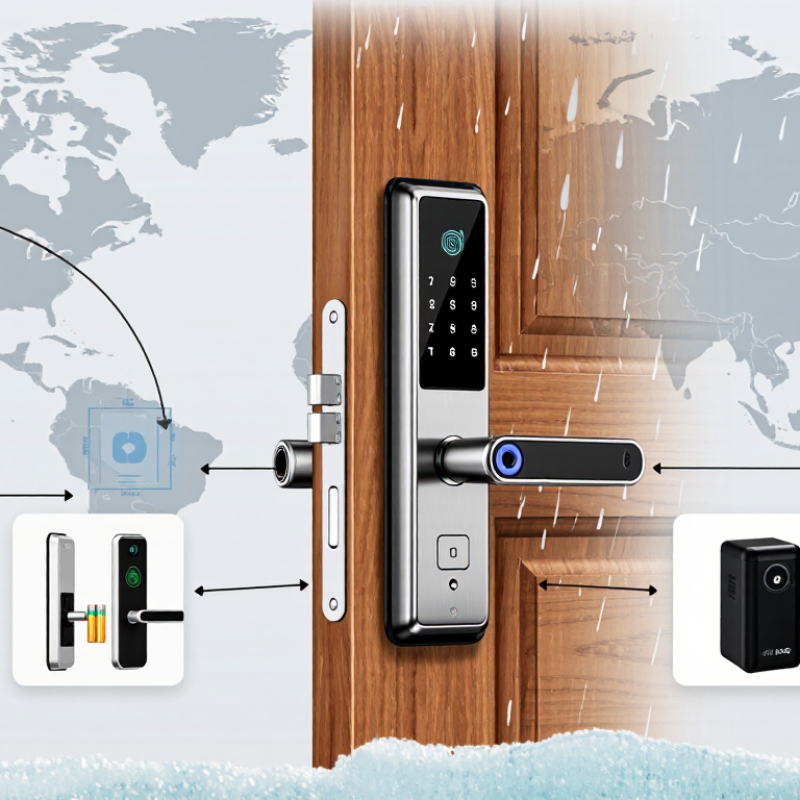
| Wireless Connectivity | 12% | Supported wireless technologies, operating frequency, communication range, gateway dependency, local fallback operation, and interoperability with the buyer’s access-control platform. | Protocol specification, frequency declaration, integration guide, interoperability test report, and a live demonstration under realistic installation conditions. | The wireless technology and frequency must be legal in every target market; the lock should retain a defined local access method if the network or gateway is unavailable. | Radio-equipment requirements differ by jurisdiction. In the European Union, applicable products may fall under the Radio Equipment Directive 2014/53/EU; local spectrum rules must also be checked. |
| Regional Compliance | 15% | Whether the complete lock system—not only the wireless module—has the approvals required for the destination market. | Declaration of Conformity, test reports from competent laboratories, technical file references, labeling samples, and country-specific import documentation. | Documentation must identify the exact model, hardware revision, radio configuration, applicable directives, and test standards. A generic certificate without model traceability should not be accepted. | Common references include RED 2014/53/EU, FCC equipment authorization requirements in the United States, UK radio-equipment rules, and applicable electrical-safety requirements. |
| Mechanical Compatibility | 12% | Door thickness, backset, center distance, spindle arrangement, handing, cylinder format, mortise dimensions, fire-door suitability, and compatibility with local door hardware. | Dimensioned mechanical drawings, installation templates, door-preparation requirements, tolerance limits, and samples installed on representative doors. | The supplier should provide a documented fit matrix and confirm compatibility before mass production; field modification of doors should not be the normal installation method. | For electromechanical locks, EN 14846 provides a recognized European reference for mechanically operated locks and striking plates. |
| Security and Credential Control | 15% | Credential enrollment, authentication method, administrator roles, lost-device handling, audit logs, encryption in transit and at rest, and protection against replay or unauthorized pairing. | Security architecture, threat model, key-management description, penetration-test summary, firmware-signing process, vulnerability-reporting channel, and sample audit logs. | The system should support unique user credentials, role-based administration, revocation of lost credentials, encrypted communications, signed firmware, and an auditable event history. | ISO/IEC 27001 concerns information-security management; ETSI EN 303 645 is a relevant baseline for cybersecurity in consumer IoT products where applicable. |
| Battery and Power Resilience | 10% | Battery chemistry, rated operating conditions, low-battery warning, emergency power method, battery-replacement process, and behavior during power loss. | Battery test protocol, environmental test results, low-voltage thresholds, emergency-unlock instructions, and measured results from representative production units. | The product should provide an early low-battery warning, a documented emergency access method, and a replacement procedure that does not damage the lock or erase authorized credentials. | Battery life is application-dependent and should be validated using a stated usage profile rather than an unsupported single headline figure. |
| Environmental Protection | 8% | Resistance to dust, water, humidity, temperature variation, corrosion, and outdoor exposure for the complete installed assembly. | Ingress-protection test report, operating-temperature range, humidity and corrosion test results, gasket specifications, and installation limitations. | The stated IP rating must apply to the tested configuration. For example, IP65 means dust-tight protection and protection against water jets, but it does not by itself prove suitability for immersion or every outdoor condition. | IEC 60529 defines IP-code protection levels. The correct rating depends on the lock’s location and the enclosure actually tested. |
| Durability and Lifecycle | 10% | Mechanical cycle life, latch or bolt endurance, clutch performance, keypad or reader durability, corrosion resistance, and spare-part availability. | Endurance-test method, cycle count, failure criteria, component life data, spare-parts list, and warranty terms for the exact model. | Testing should use production-equivalent units and disclose load, alignment, temperature, door type, and failure criteria. A cycle count without test conditions is not sufficient for comparison. | EN 14846 includes classification and performance concepts relevant to electromechanical locks; project-specific requirements may require additional testing. |
| Factory Quality System | 8% | Incoming inspection, process controls, final inspection, software-version control, traceability, nonconformance handling, and corrective-action procedures. | Current quality-management certificate, audit summary, inspection plan, sample control records, serial-number traceability, and corrective-action report with sensitive information removed. | The quality system should cover the actual manufacturing site and product scope. ISO 9001 certification is useful evidence of a management system but is not proof that every lock is safe or reliable. | ISO 9001 specifies requirements for a quality-management system; it does not certify product performance or cybersecurity. |
| Software, Cloud, and API Support | 5% | Mobile-app support, cloud hosting region, API availability, data export, account ownership, service continuity, update policy, and integration with property-management systems. | API documentation, service-level terms, data-processing terms, update policy, supported operating systems, backup procedures, and exit plan for account or platform migration. | Buyers should be able to export essential access records, identify data-processing locations, and operate critical access functions if cloud service is interrupted. | Privacy and data-transfer obligations depend on the countries involved; contract terms should address personal data, retention, deletion, and breach notification. |
| Customization and Documentation | 3% | Language support, firmware configuration, packaging, labeling, access modes, mechanical variants, and documentation quality. | Product-change procedure, engineering-change notice process, multilingual manuals, installation videos, packaging artwork, and configuration-management records. | Any change to radio components, firmware, battery type, enclosure, or locking mechanism should trigger documented review and, where necessary, renewed compliance testing. | Regulatory conformity generally applies to the product configuration that was assessed; undocumented substitutions can invalidate previous test evidence. |
| Commercial and After-Sales Capability | 2% | Minimum order quantity, lead time, sample policy, warranty response, replacement parts, technical support, training, and long-term product availability. | Quotation with Incoterms, production lead-time schedule, warranty policy, service-contact details, spare-parts plan, and references to completed projects without relying only on marketing claims. | The supplier should provide a clear escalation path, defined response times, replacement procedures, and written notice for end-of-life or major firmware changes. | Commercial terms are contractual rather than universal technical standards and should be evaluated alongside total cost of ownership. |