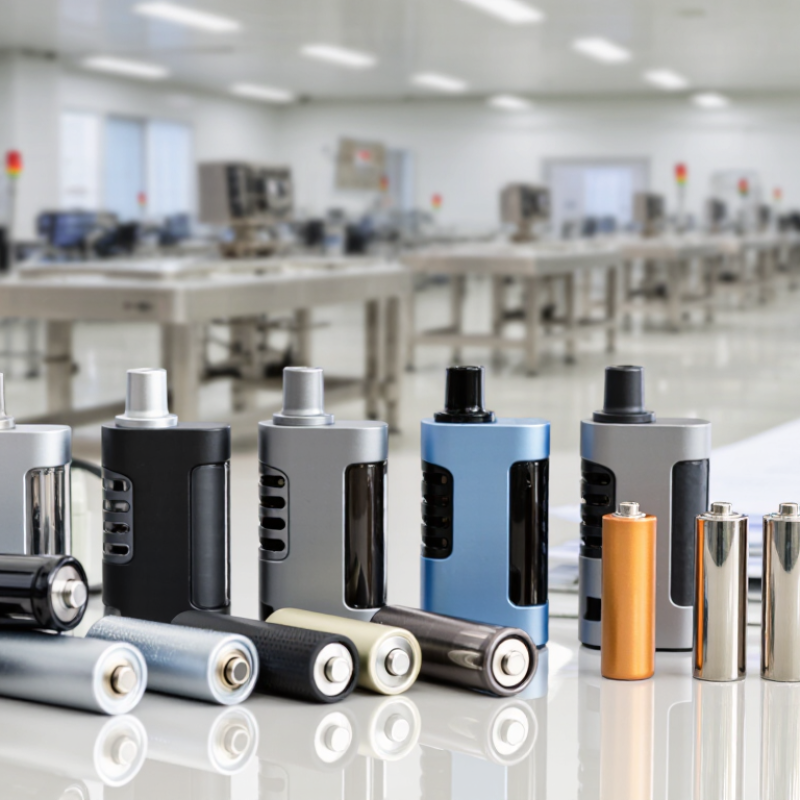
| 1 | Cell chemistry | Most rechargeable vape batteries use lithium-ion chemistry because it provides high energy density in a compact cylindrical or pouch format. | Common nominal voltage: 3.6–3.7 V for standard lithium-ion cells; charging voltage is commonly 4.2 V. | Cell datasheet, chemistry declaration, rated capacity, nominal voltage, charge voltage, and discharge specifications. |
| 2 | Battery format | Compact cylindrical cells are widely used where the product requires a small footprint and standardized mechanical dimensions. | Frequently specified formats include 18650 and 21700; smaller custom pouch cells are also used in integrated devices. | Dimensional drawing, terminal configuration, weight, tolerance range, and sample inspection report. |
| 3 | Capacity consistency | Actual capacity depends on discharge conditions, temperature, cutoff voltage, cell age, and testing method; advertised capacity should not be evaluated without test conditions. | Capacity should be reported in mAh with discharge current, end-of-discharge voltage, temperature, and test method. | Incoming inspection report, batch test data, capacity distribution, and independent sample test results. |
| 4 | Discharge performance | The required discharge current must match the device design. A higher nominal capacity does not automatically mean a higher safe continuous-discharge capability. | Review continuous and pulse discharge ratings separately; confirm temperature limits and cutoff conditions. | Load-profile test, continuous-discharge curve, pulse test data, internal-resistance report, and thermal test results. |
| 5 | Protection and safety design | Battery packs may require protection against overcharge, over-discharge, short circuit, and excessive current. Protection requirements depend on the device architecture. | Verify protection thresholds, response time, temperature protection, and whether the pack includes a protection circuit module. | Protection-circuit schematic, threshold test records, abnormal-condition test report, and safety risk assessment. |
| 6 | Transportation compliance | Lithium-ion batteries offered for air transport generally require evidence of testing under the UN Manual of Tests and Criteria, Part III, Sub-section 38.3. | UN 38.3 test summary, packaging instructions, state-of-charge requirements, and applicable transport classification. | UN 38.3 test summary, Safety Data Sheet, commercial invoice data, packing declaration, and shipping documentation. |
| 7 | Product safety testing | IEC 62133-2 is a commonly referenced safety standard for portable sealed secondary lithium cells and batteries, subject to the final product scope and destination-market requirements. | Testing may cover electrical abuse, mechanical safety, molding stress, external short circuit, overcharge, and forced discharge. | Accredited laboratory test report, certificate scope, model list, and report validity confirmation. |
| 8 | Regulatory and environmental documentation | Import requirements vary by destination. Buyers should distinguish mandatory legal requirements from voluntary declarations and market-access marks. | Common documentation areas include RoHS material compliance, REACH-related declarations, battery labeling, and regional recycling obligations. | Declaration of conformity, restricted-substance report, material declaration, labeling artwork, and destination-country compliance file. |
| 9 | Traceability and quality control | Battery performance can vary by cell lot and production date, so traceability is essential for recalls, warranty analysis, and quality investigations. | Traceability should link raw materials, cell lot, production date, inspection results, and shipment batch. | Batch coding method, quality-control plan, incoming-material records, final inspection data, and corrective-action procedure. |
| 10 | Commercial supply capability | Lead time, minimum order quantity, customization capability, warranty terms, and after-sales response should be assessed using a verified sample order rather than a quotation alone. | Evaluate sample approval, production capacity, quality acceptance limits, packaging, replenishment planning, and delivery performance. | Company registration details, factory audit results, sample-order records, quality agreement, warranty policy, and shipment references. |