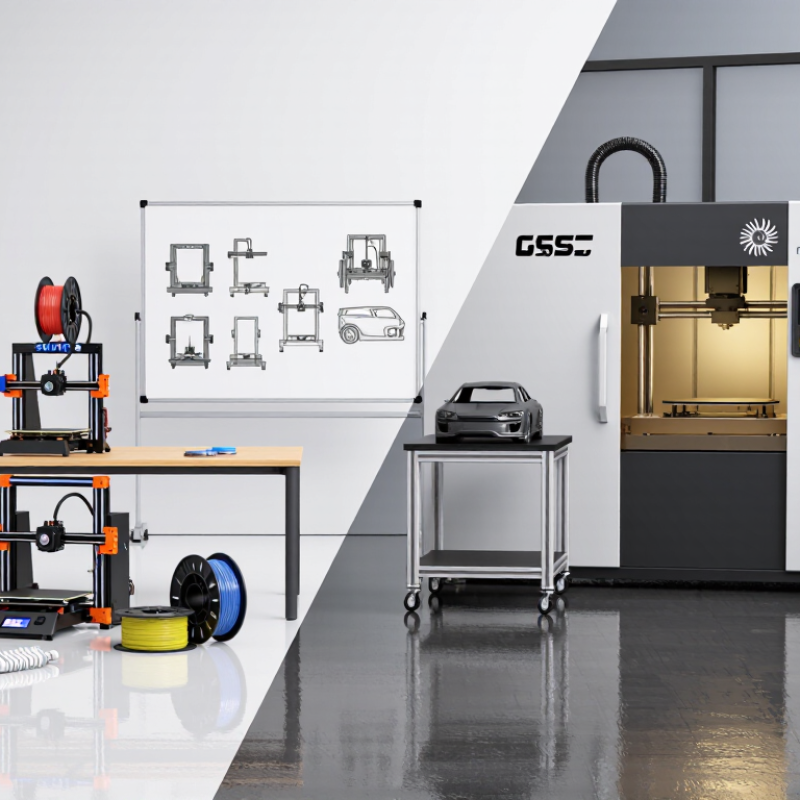
| FDM / FFF | Low-cost functional prototypes, fixtures, educational models, replacement parts, and large-format concepts | PLA, PETG, ABS, ASA, TPU, nylon, polycarbonate, and fiber-reinforced filaments | About 0.05–0.40 mm | Approximately 180 × 180 × 180 mm to more than 300 × 300 × 300 mm | Lowest entry cost, broad material selection, simple material storage, and relatively easy maintenance | Visible layer lines, anisotropic strength, warping with some materials, and more support cleanup for complex shapes | Beginners, schools, hobbyists, makers, and engineering teams needing economical prototypes |
| SLA / MSLA / DLP | Highly detailed miniatures, dental and jewelry patterns, visual prototypes, and smooth-surface models | Photopolymer resins, including standard, tough, flexible, castable, dental, and high-temperature formulations | About 0.025–0.10 mm | Approximately 130 × 80 × 160 mm to about 300 × 200 × 300 mm | Excellent fine detail, smooth surfaces, and consistent dimensional reproduction for small parts | Liquid resin handling, washing and UV post-curing, consumable replacement, and limited outdoor durability for some resins | Designers, model makers, dental laboratories, jewelers, and users prioritizing detail over part size |
| SLS | Durable functional prototypes, complex assemblies, internal channels, lattice structures, and small-batch production | Nylon powders, glass-filled nylon, aluminum-filled polyamide, and selected elastomeric powders | About 0.06–0.15 mm | Typically around 165 × 165 × 185 mm to approximately 380 × 380 × 300 mm | No dedicated support structures, strong and complex parts, and efficient batch nesting | Higher equipment and material cost, powder handling, surface grain, and the need for depowdering equipment | Professional product developers, service bureaus, and manufacturers producing functional nylon parts |
| MJF | Fast production of multiple functional polymer parts, enclosure components, and customized product batches | Primarily nylon-based powders, including standard and reinforced polyamide formulations | About 0.08–0.12 mm | Often around 380 × 284 × 380 mm, depending on the system | High throughput, good mechanical performance, efficient batch production, and strong nesting capability | High capital cost, powder management requirements, and a more specialized workflow than desktop systems | Manufacturers, service providers, and engineering teams focused on production-grade polymer parts |
| Material Jetting | Full-color appearance models, multi-material prototypes, design validation, and realistic product presentations | Photopolymer materials, including rigid, flexible, transparent, and color-capable resins | About 0.016–0.032 mm | Commonly around 490 × 390 × 200 mm to approximately 1,000 × 800 × 500 mm | Very high visual quality, smooth surfaces, color capability, and multiple material properties in one model | High operating cost, resin aging, support-material waste, and limited long-term durability for some applications | Professional design studios, consumer-product teams, and organizations requiring presentation-ready models |
| Selective Laser Melting / Laser Powder Bed Fusion | Metal prototypes, lightweight aerospace structures, medical components, tooling, and low-volume metal production | Stainless steel, aluminum, titanium, cobalt-chrome, tool steel, and nickel-based alloys | About 0.020–0.060 mm | Typically around 100 × 100 × 100 mm to approximately 400 × 400 × 400 mm | Produces dense metal parts with complex geometries, internal channels, and high-performance material properties | Very high equipment cost, inert-gas requirements, powder safety controls, support removal, and heat treatment | Industrial manufacturers, aerospace and medical engineering teams, and specialized metal-production facilities |