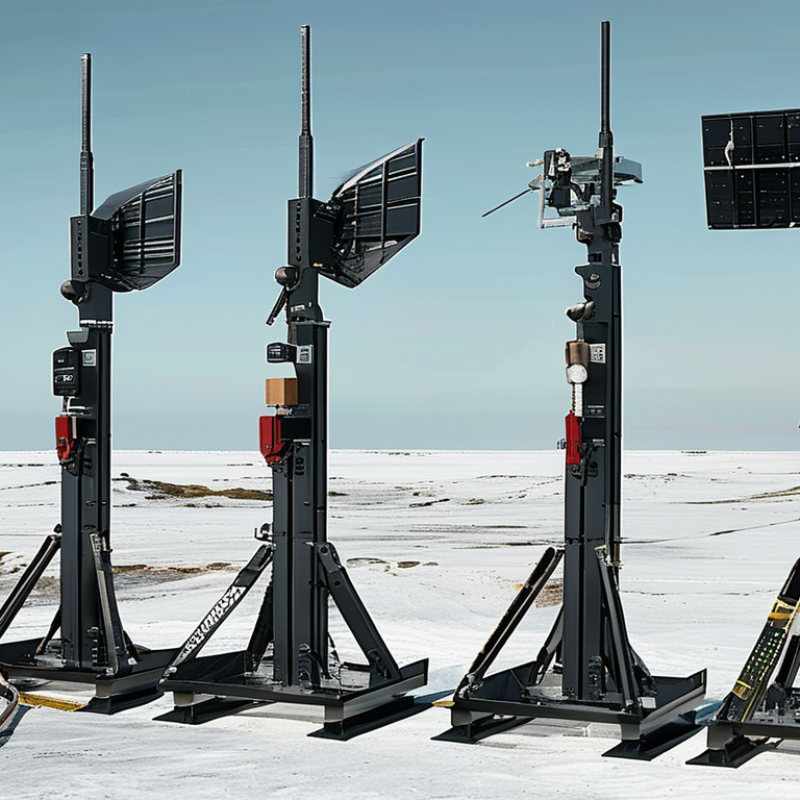
| Pole-Mount Rack | Ground, concrete footing, or an existing structural pole | Approximately 0.6–2.4 m diameter | About 1.5–4.5 m above ground; footing commonly 0.6–1.2 m wide | Not applicable when ground-mounted | Good elevation, clear signal path, strong resistance to accidental contact, and flexible azimuth adjustment | Requires excavation or a verified structural support; wind loads increase with height | Large dishes, remote sites, and installations requiring obstruction clearance |
| Wall-Mount Rack | Masonry or reinforced exterior walls | Approximately 0.45–1.2 m diameter | Bracket projection commonly 0.3–0.8 m from the wall | No roof penetration; wall anchors are required | Compact, economical, easy to access, and suitable for many residential or commercial buildings | Limited by wall strength, edge distance, local wind exposure, and line-of-sight obstructions | Small to medium dishes installed on structurally sound walls |
| Roof-Penetrating Rack | Structural roof framing, equipment platforms, or roof curbs | Approximately 0.6–2.4 m diameter | Usually 0.3–1.5 m above the roof surface | Yes; waterproof flashing and structural reinforcement may be needed | High stability, precise alignment, and suitability for heavier equipment | Higher installation complexity, potential leakage risk, and greater maintenance responsibility | Permanent commercial, institutional, or broadcast installations |
| Non-Penetrating Roof Rack | Flat roofs with adequate ballast capacity | Approximately 0.6–1.8 m diameter | Typical footprint: 1.2–2.5 m long × 1.0–2.0 m wide | No | Avoids roof drilling, can reduce waterproofing work, and is relatively easy to relocate | Adds dead load, needs wind assessment, and may not suit steep or weak roofs | Leased buildings and flat-roof installations where penetrations are undesirable |
| Tripod Roof Rack | Pitched or flat roofs with suitable structural attachment points | Approximately 0.6–1.2 m diameter | About 0.6–1.5 m high; base commonly 0.9–1.8 m across | Usually yes, although some versions use structural clamps | Stable three-point support, good adjustment range, and broad compatibility with medium dishes | Requires careful flashing or attachment; may be unsuitable for fragile roofing materials | Residential and light commercial roofs with sufficient structural capacity |
| Ground-Frame Rack | Concrete pads, driven posts, or prepared ground platforms | Approximately 0.9–3.7 m diameter | Typical footprint: 1.5–4.0 m long × 1.5–4.0 m wide | Not applicable | Excellent service access, strong load distribution, and suitability for large or multiple dishes | Needs available land, site preparation, drainage consideration, and protection from vegetation or vandalism | Large communication systems, campuses, and dedicated satellite ground stations |
| Portable or Temporary Rack | Temporary field sites, events, emergency communications areas, or test locations | Approximately 0.45–1.0 m diameter | Folded length commonly 1.0–2.0 m; deployed footprint about 1.0–2.0 m | No permanent penetration | Fast deployment, easy transportation, and low site commitment | Lower long-term stability, limited dish size, and greater sensitivity to movement or high winds | Short-duration links, field operations, and backup communications |