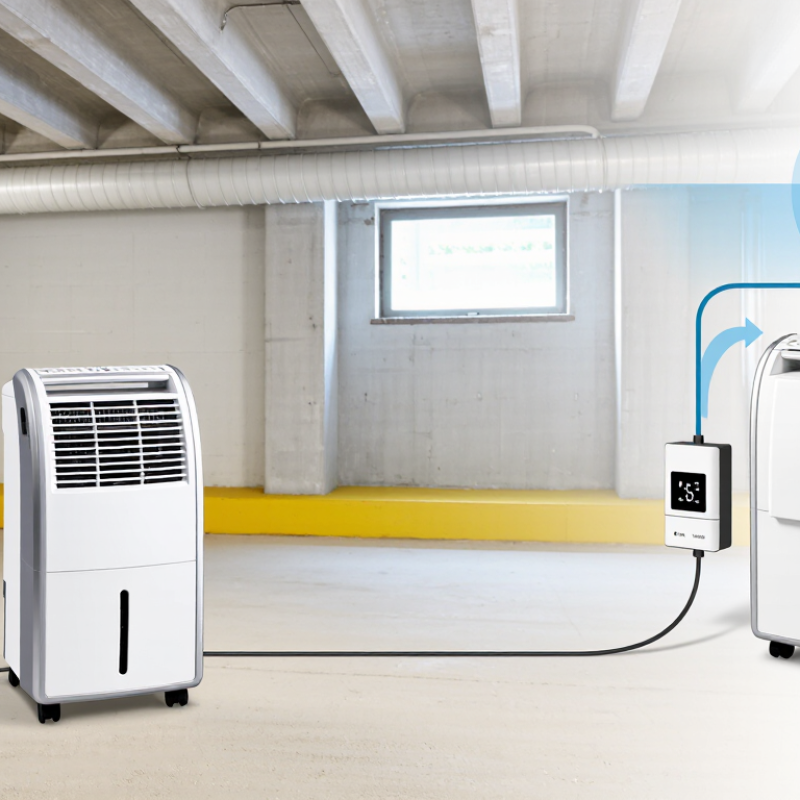
| Primary Function | Monitors indoor relative humidity and controls when a dehumidifier operates. | It compares measured humidity with a selected target and switches the equipment on or off. |
| Measured Parameter | Relative humidity, expressed as a percentage (%RH). | Relative humidity indicates how much water vapor is present in the air compared with the maximum amount the air can hold at the same temperature. |
| Common Indoor Target | Approximately 40%–60% RH for general comfort and moisture management. | The appropriate target depends on temperature, building conditions, occupant comfort, and the risk of condensation or mold growth. |
| Humidity Sensor | Usually an electronic capacitive or resistive humidity sensor. | The sensor detects changes in moisture content by measuring an electrical property that varies with humidity. |
| Measurement Process | The sensor samples air near the controller or inside the dehumidifier. | An electronic circuit converts the sensor signal into a humidity reading, which may be shown on a display or used internally. |
| Control Setpoint | A user-selected humidity level, such as 50% RH. | The controller uses the setpoint as the reference for deciding whether moisture removal is needed. |
| Switch-On Condition | Measured RH rises above the control threshold. | The controller sends an electrical signal to start the dehumidifier or activate its moisture-removal cycle. |
| Switch-Off Condition | Measured RH falls to or below the lower control limit. | The controller stops the dehumidifier to prevent unnecessary operation and excessive drying. |
| Hysteresis | A small difference between the switch-on and switch-off humidity levels. | Hysteresis reduces rapid on-and-off cycling caused by minor sensor fluctuations. For example, a controller may start above 55% RH and stop near 50% RH. |
| Temperature Compensation | Some controllers measure both humidity and air temperature. | Temperature affects relative humidity, so compensation can improve reading stability and help identify condensation risk. |
| Output Signal | A relay, low-voltage control signal, or compatible switching output. | The output connects the humidity decision to the dehumidifier, ventilation system, or another moisture-control device. |
| Airflow Requirement | The sensor needs access to representative room air. | Blocked vents, direct airflow, sunlight, heaters, or placement near moisture sources can produce inaccurate readings. |
| Typical Response Delay | The displayed or detected humidity may take time to stabilize after environmental changes. | A short delay helps prevent unnecessary switching when humidity changes temporarily or when air has not fully mixed. |
| Measurement Accuracy | Accuracy varies by sensor quality, calibration, temperature, airflow, and operating range. | A controller reading is an estimate of local air conditions and may differ from a separate meter placed elsewhere. |
| Basic Operating Sequence | Sense → calculate → compare → switch → recheck. | The controller repeatedly measures humidity, compares it with the setpoint and hysteresis limits, operates the equipment, and then checks the air again. |