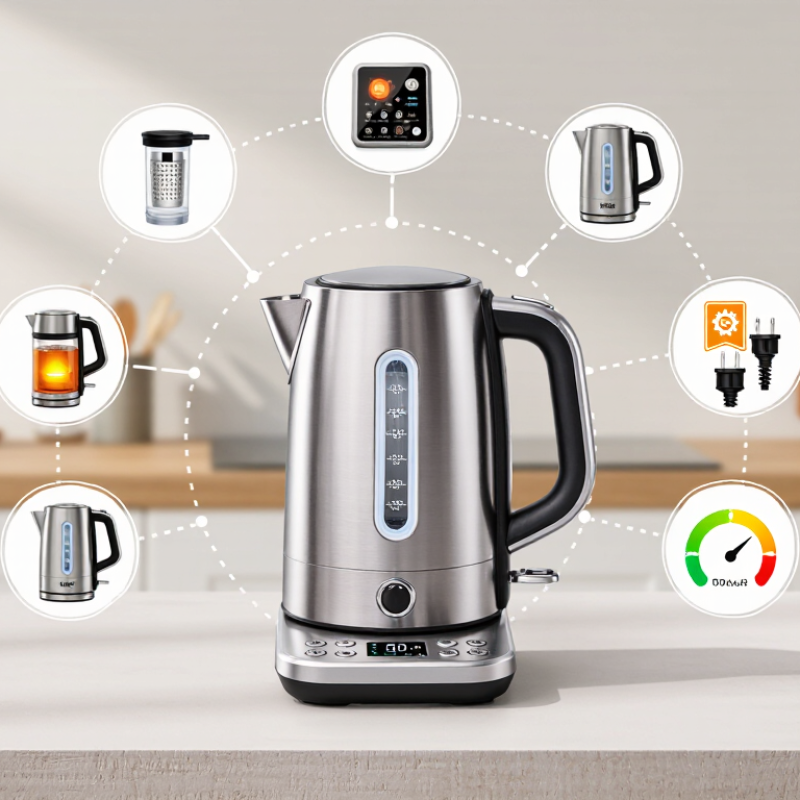
| 01 | Check voltage compatibility | Confirm the rated voltage and frequency on the product label match the destination market and intended use. Mains supplies commonly fall within 100–120 V or 220–240 V ranges, but requirements vary by country. | Using a kettle outside its rated electrical supply can cause malfunction or create a safety risk. Do not assume a plug adapter converts voltage. |
| 02 | Match the plug and power rating | Specify the destination plug type, rated wattage, and any applicable local electrical requirements. Ask for the rating label and product documentation for the exact configuration being purchased. | Plug shape, outlet capacity, and electrical requirements differ between markets. A suitable plug alone does not confirm that the appliance is electrically compatible. |
| 03 | Review market-specific compliance | Identify the rules for each destination market and request relevant declarations, test reports, or certificates for the exact model. Examples include CE marking for applicable EU legislation, UKCA marking where applicable in Great Britain, and recognized safety certifications for North American markets. | Compliance requirements depend on the product and destination. A marking or document should be verified for scope, model, and issuing party; it is not automatically valid in every country. |
| 04 | Check food-contact materials | Ask for the bill of materials for water-contact parts, such as the inner vessel, lid, filter, and seals. Request applicable food-contact compliance documentation for the markets where the kettle will be sold. | Material suitability and documentation requirements vary by jurisdiction. Clear material specifications help buyers assess quality, labeling, and regulatory obligations. |
| 05 | Confirm capacity and intended use | Compare usable capacity, minimum and maximum fill marks, and the intended household or workplace use. Check that the design supports the expected serving size and countertop space. | Capacity affects how much water can be heated per cycle and helps buyers select a model suited to their users without relying on appearance alone. |
| 06 | Inspect safety features | Verify whether the model includes automatic shut-off after boiling, boil-dry protection, a stable base, and a lid designed to reduce accidental spills. Confirm these features in the product specification and sample testing. | These features can help reduce common operating hazards. Their presence and performance should be checked on the actual model rather than assumed from a product description. |
| 07 | Assess temperature and multipurpose functions | For models with temperature settings or keep-warm functions, check the available settings, operating instructions, and behavior after the selected cycle. Verify that controls are clearly labeled for the target market. | Functionality differs between models. Clear specifications and user instructions help buyers assess whether extra features suit their customers and intended applications. |
| 08 | Read warranty terms carefully | Confirm the warranty period, start date, covered components, exclusions, claim process, and who pays transport or replacement costs. Request written terms that apply to the export order. | Warranty coverage is set by the seller or contract and may vary by market. Written terms reduce uncertainty about after-sales responsibilities. |
| 09 | Evaluate supplier support | Ask whether the supplier can provide manuals, spare-parts information, troubleshooting guidance, product traceability, and a named contact for quality or warranty issues. Confirm response channels and working hours. | Accessible documentation and support can make product onboarding and issue resolution more manageable for importers and distributors. |
| 10 | Test samples and export packaging | Evaluate a pre-production or production sample, review packaging dimensions and protection, and agree on inspection criteria, labeling, and shipment documents before placing a bulk order. | Sample checks can reveal differences between specifications and delivered goods. Packaging and documentation should be suitable for the agreed transport route and destination requirements. |