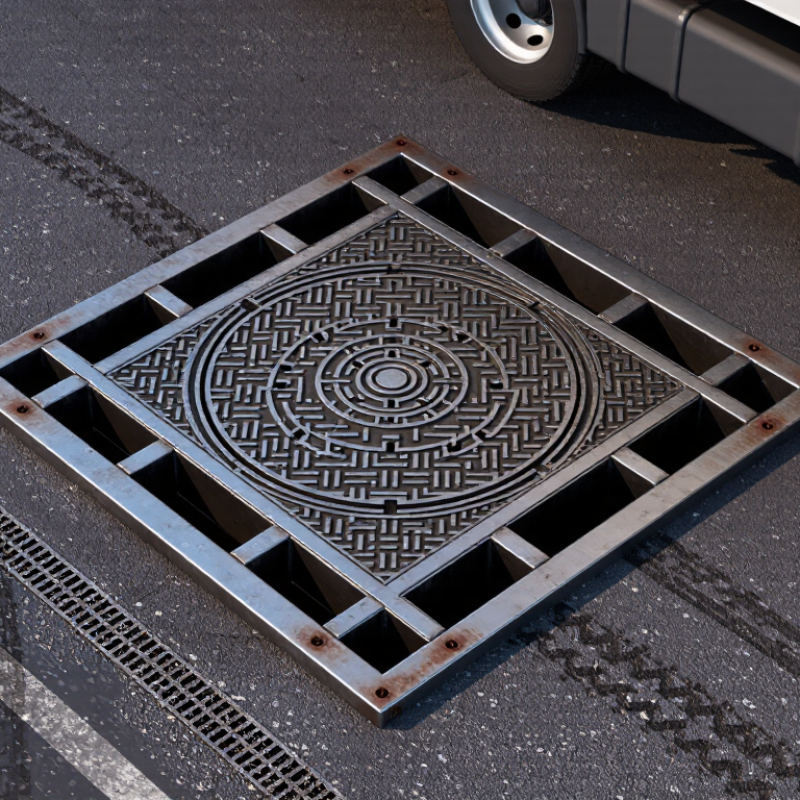
| Basic Form | Square cover and frame | Common nominal clear openings include approximately 450 × 450 mm, 600 × 600 mm, and 900 × 900 mm. | Provides access to underground drainage, utility, inspection, and service chambers. | Actual external dimensions, clear opening, and depth vary according to the chamber design and applicable local requirements. |
| Primary Material | Ductile iron | High-strength iron containing graphite in a nodular form; commonly selected for vehicular and utility access covers. | Resists bending, impact, wear, and repeated wheel loading while allowing relatively compact sections. | Corrosion protection may include coating, painting, or other specified treatments. Material grade and casting quality should be verified from the product specification. |
| Primary Material | Grey cast iron | Iron with flake graphite; generally more brittle and less impact-resistant than ductile iron. | Provides compressive strength and mass for light-duty access applications. | Not normally the first choice where heavy traffic, impact, or significant deformation resistance is required. |
| Primary Material | Carbon or stainless steel | Steel plates and fabricated sections can be produced in various thicknesses and profiles. | Offers high tensile strength and can be adapted for reinforced covers, hinged assemblies, or special access requirements. | Carbon steel requires corrosion protection; stainless steel improves corrosion resistance but generally increases material cost. |
| Alternative Material | Polymer concrete or fibre-reinforced composite | Non-metallic construction with lower density than iron-based covers. | Reduces lifting weight and can provide resistance to moisture, salts, and some chemical environments. | Load capacity, ultraviolet resistance, fire performance, and long-term creep behavior must be checked for the intended installation. |
| Load Classification | EN 124 load classes | A15: 15 kN; B125: 125 kN; C250: 250 kN; D400: 400 kN; E600: 600 kN; F900: 900 kN test load. | Indicates the tested load category for a cover and frame assembly under the relevant standard. | The correct class depends on the installation location, traffic exposure, support conditions, and the standard adopted for the project. |
| Load-Bearing Part | Cover plate or lid | May be solid, recessed, perforated, or fitted with a non-slip surface; thickness and rib layout depend on the required load class. | Transfers pedestrian, wheel, and impact loads to the supporting frame. | A square lid should be designed to prevent rocking, excessive deflection, and accidental displacement during service. |
| Stiffening System | Underside ribs or reinforcing bars | Ribs are commonly arranged as transverse, longitudinal, diagonal, or grid-like supports. | Increases bending stiffness and distributes concentrated loads across the cover. | Rib geometry must leave sufficient clearance for the frame, lifting tools, drainage, and maintenance access. |
| Support Component | Frame and bearing flange | The frame surrounds the clear opening and provides a continuous seating surface for the lid. | Transfers loads from the cover into the chamber surround, concrete collar, or supporting structure. | Correct leveling, full bearing contact, and adequate surrounding concrete support are essential to reduce rocking and edge failure. |
| Seating Detail | Machined or fitted bearing surfaces | Contact surfaces may be flat, tapered, or fitted with an elastomeric noise-reduction insert. | Improves stability and can reduce vibration, rattling, and impact between the lid and frame. | Debris, poor alignment, and worn inserts can prevent full contact and may create unsafe movement under traffic. |
| Security Feature | Locking mechanism | Options include captive bolts, key-operated locks, spring latches, or tamper-resistant fasteners. | Helps prevent unauthorized opening, theft, and accidental displacement. | The mechanism should remain accessible for authorized maintenance and resist corrosion in the installation environment. |
| Access Feature | Lifting keyholes or access slots | Openings are positioned to accept compatible lifting tools and may be recessed or protected. | Allows safe removal of the cover without damaging the lid or frame. | Opening dimensions and spacing should match the specified lifting tool and should not create a trip hazard when the lid is installed. |
| Optional Feature | Hinges and captive retention | A hinged lid remains connected to the frame and may include a locking or opening-limiting device. | Reduces the risk of lid loss and improves handling during inspection and maintenance. | Hinge pins, stops, and retainers must be designed for repeated operation and protected against blockage by dirt or corrosion. |
| Surface Treatment | Protective coating or finish | Common approaches include bituminous coatings, paint systems, powder coatings, galvanizing, or corrosion-resistant alloys. | Helps protect the cover and frame from moisture, de-icing salts, wastewater exposure, and soil contact. | Coating selection should account for abrasion, chemical exposure, surface preparation, and the expected service environment. |
| Installation | Concrete surround and bedding | A stable, level surround is required to support the frame continuously around the opening. | Distributes applied loads into the surrounding pavement or chamber structure. | Insufficient support, uneven bedding, or premature loading can cause settlement, cracking, frame distortion, and cover rocking. |