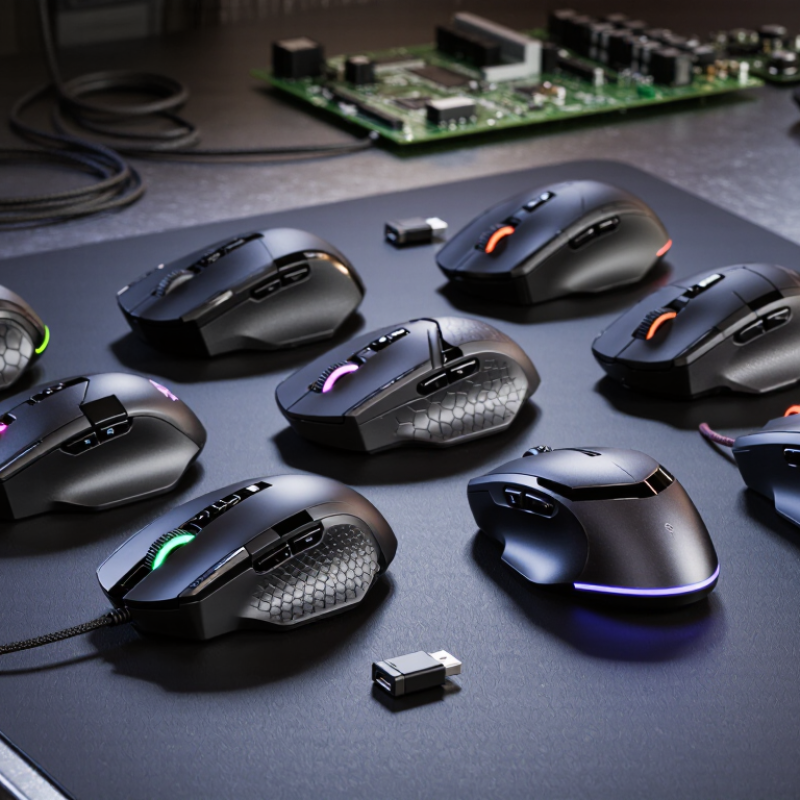
What Are the Top Gaming Mouse Manufacturers in China?

China has become an important source of gaming peripherals, but choosing a manufacturer takes more than comparing prices. In the mouse Gaming market, a convincing product must perform well in daily use, not just look impressive in a catalog. Buyers should examine sensor tracking, switch feel, shell fit, cable flexibility, and software support. Small details matter. A mouse that feels comfortable during a short demo may cause fatigue after several hours.

This guide looks at leading Chinese manufacturers through practical criteria: product development, production consistency, quality checks, customization options, and after-sales support. For example, a buyer can ask whether sample units match later production batches, how defects are handled, and whether replacement parts are available. These questions help distinguish a reliable supplier from one with only polished marketing. Still, no shortlist can fit every business. A company seeking a lightweight esports model may value different features from a retailer sourcing durable office-and-gaming designs. There is room for uncertainty, too: published specifications do not always reveal long-term comfort or real-world reliability. Comparing samples and requesting clear documentation remains sensible. The manufacturers covered here offer useful starting points, not automatic guarantees.

What Are the Top Gaming Mouse Manufacturers in China?

China’s Gaming Mouse Manufacturing Landscape

China’s gaming mouse manufacturing landscape is built around dense electronics supply chains, especially in southern manufacturing hubs. Nearby suppliers can provide sensors, switches, cables, plastic housings, and packaging. This proximity often shortens prototype cycles and makes design changes easier. Small details matter. A shell’s surface texture, cable flexibility, and scroll-wheel resistance can shape the user experience.

Many factories offer OEM or ODM production, from basic assembly to custom tooling and firmware. Buyers should look beyond product photos. Ask how each sample is tested, whether tracking remains stable across different surfaces, and how factories check button consistency. Request clear inspection records and compare samples from separate production runs. A smooth first sample is not enough.

The landscape is varied. Some manufacturers focus on high-volume models, while others handle smaller custom orders. Their capabilities and quality systems can differ, even within the same region. The picture is not perfectly neat. A low quotation may omit testing or packaging details, and buyers sometimes overlook those gaps. Confirm lead times, component substitutions, and defect-handling procedures in writing. Then test the mouse in real use, not only on a specification sheet.

Criteria for Ranking Gaming Mouse Manufacturers

Ranking Chinese gaming mouse manufacturers should start with measurable engineering, not product photos. Compare sensor tracking accuracy, click latency, wireless stability, and shell consistency across several production samples. A mouse that feels precise on one desk may behave differently on a cloth pad or during fast, repeated swipes. Check whether the manufacturer publishes test methods, keeps batch-level quality records, and can explain how it handles defects. These details reveal more than a long feature list.

Scale matters, but it is not proof of quality. Grand View Research estimated the global gaming peripherals market at about USD 6.3 billion in 2023 and projected 10.3% annual growth from 2024 to 2030. That wider category includes more than mice, so it cannot rank factories by itself. Use it as context, then assess a supplier’s tooling investment, in-house testing, production capacity, component traceability, and responsiveness to technical questions. Also review certifications and export documentation relevant to the buyer’s target market. No scorecard is perfect. I would give repeatable test results more weight than impressive specifications, while noting that independent factory data can be hard to verify.

Tips: Request samples from different production batches. Test click feel, wheel steps, sensor tracking, and wireless performance on the same setup. Ask for written defect-rate data and a clear warranty process; vague answers deserve a lower score.

Leading Chinese Gaming Mouse Manufacturers and Their Brands

China’s gaming mouse sector includes manufacturers that sell products under their own house brands and factories that develop devices for outside labels. Some companies do both. Their work can cover sensor integration, shell tooling, switches, firmware, and final assembly. The distinction matters: a familiar brand may not own the factory, while one manufacturer may support several product lines.

A house brand’s identity often comes through design choices. One may favor a compact shell, textured sides, and lightweight construction; another may focus on adjustable buttons or wireless connectivity. Look beyond appearance. Check the stated sensor model, polling rate, switch type, software support, and warranty terms. Clear specifications are more useful than broad claims about speed or precision.

Manufacturing quality still varies between models. A mouse can feel solid in a showroom but develop uneven clicks after extended use. Small details matter. For business buyers, sample testing and consistent inspection records help reveal issues before a large order. It is also worth asking who handles firmware updates and replacement parts. Not every manufacturer communicates these details well, and that is a weakness worth noting.

Key Technologies and Product Specialties

China’s gaming-mouse manufacturers often differentiate through sensor integration, wireless performance, and fast product customization. Newzoo’s 2024 Global Games Market Report estimated worldwide game revenue at $187.7 billion, reflecting a large audience with varied play styles. That scale helps explain demand for lightweight shells, adjustable sensor settings, and reliable wireless links. Small details matter. A mouse should track smoothly during quick turns, not just post an impressive specification on its box.

Product specialties often start with the shape. Some designs use compact, symmetrical shells for fingertip control; others add a pronounced hump for palm support. Optical sensors, low-latency wireless systems, and configurable polling rates serve competitive players, while durable switches and simplified software suit everyday use. Manufacturers may also offer different feet, cable options, or shell finishes for regional preferences. These features need testing on real surfaces, with repeated clicks and long sessions. Published specifications alone cannot show firmware stability or quality-control consistency. That gap deserves attention. Buyers and product teams should compare measured tracking, battery life, and comfort—not rely on headline numbers.

Gaming Mouse Technologies: Polling Rate and Signal Interval

Representative USB polling-rate tiers used in gaming mice. The signal interval is calculated as 1,000 milliseconds divided by the polling rate; these figures describe technology specifications, not individual manufacturers or product quality.

How to Select a Chinese Gaming Mouse Manufacturer

When selecting a Chinese gaming mouse manufacturer, compare engineering depth, quality controls, and communication—not just unit price. Grand View Research estimated the global gaming peripherals market at about US$4.4 billion in 2023, with projected growth of 7.7% annually from 2024 to 2030. That growth can encourage fast launches, but a polished catalogue does not prove reliable production. Ask whether the supplier designs the mouse in-house or mainly assembles components, and request clear records for materials, inspection steps, and defect handling.

Test production samples on the surfaces and games your customers actually use. Check sensor tracking, lift-off behavior, button consistency, scroll-wheel wobble, and cable strain. Then compare sample results with the written specification. Ask for the expected lifespan of switches and scroll-wheel components, plus the method used to test them. Request an audit or a live production walkthrough, and confirm minimum order quantities, tooling ownership, lead times, and change-control procedures in writing. Small details matter. A sample may feel excellent while later batches vary, so include measurable acceptance criteria in the purchase agreement.

Tips: Request two or three samples from separate production runs. Keep one as a reference unit, and ask an independent testing lab to verify performance claims when the order is substantial. I would still recheck any unusually low quote; I may miss something, but unexplained cost gaps deserve questions.

What Are the Top Gaming Mouse Manufacturers in China? — How to Select a Chinese Gaming Mouse Manufacturer

Use this supplier-selection checklist to compare manufacturing capabilities rather than company names. Specifications and commercial terms vary by model and should be verified for each quotation.

Evaluation Dimension Practical Benchmark or Data Point What to Verify with the Manufacturer Why It Matters
Product design and development Confirm whether the supplier offers OEM production, ODM development, or both. Request the available design scope, engineering workflow, prototype process, and ownership terms for custom tooling and design files. Clarifies how much product development the supplier can handle and who controls the resulting intellectual property.
Sensor performance Gaming mouse sensor specifications commonly span from several thousand DPI to above 20,000 DPI, depending on the sensor and model. Ask for the exact sensor model, tested DPI steps, tracking data, and a sample for hands-on evaluation. Treat maximum DPI as one specification, not a complete measure of performance. Sensor accuracy, tracking consistency, and implementation affect real-world use more than a headline DPI figure alone.
Polling rate and connection 1,000 Hz is a common wired or wireless gaming-mouse polling rate; some models offer 4,000 Hz or 8,000 Hz. Confirm supported rates, connection mode, receiver requirements, and whether the stated rate is available in the final production configuration. Helps match the product to the intended market and avoid confusing a feature on a prototype with a production specification.
Switches and rated life Switch lifetime claims are commonly expressed in millions of clicks; actual ratings differ by switch type and model. Request the switch specification and test documentation. Confirm whether the rating refers to the switch component or the complete mouse. Click feel, consistency, and durability are important for gaming use; component ratings should not be mistaken for guaranteed product life.
Weight and ergonomics Lightweight gaming models are often around 50–80 g, while other designs may be heavier. Check finished-product weight, dimensions, handedness, grip suitability, button layout, and sample comfort. Weight and shape are subjective and can strongly affect user preference, so samples are essential before a large order.
Wireless battery and charging Battery capacity, operating time, and charging time vary by design, polling rate, lighting, and usage conditions. Request battery capacity, runtime test conditions, charging method, and test results for the intended wireless configuration. Runtime claims are only comparable when the test settings and usage conditions are clearly stated.
Quality management Ask whether the factory uses incoming-material checks, in-process inspections, and final functional testing. Request a sample inspection checklist, defect-handling process, production test records, and the agreed acceptance criteria for the order. A documented process is more useful than an unsupported general claim of “high quality.”
Compliance and target markets Requirements depend on the destination market and the product’s electrical, radio, battery, and material characteristics. Identify applicable requirements before production and verify that certificates or test reports match the exact model and configuration. Compliance documents for a different product or configuration may not establish that the ordered mouse meets the applicable requirements.
Customization and packaging Possible options include shell colors, surface finishes, logos, switches, cables, packaging, and software features. Get a written specification showing which options are available, their cost, tooling implications, and approval process. Written customization details reduce the risk of differences between the approved sample and mass production.
MOQ, pricing, and lead time Minimum order quantity, unit price, sample charges, and lead time are supplier- and configuration-specific. Request a quotation that separates sample, tooling, unit, packaging, and shipping costs; confirm production and sample timelines in writing. Comparing itemized quotations makes suppliers easier to evaluate and exposes costs that may otherwise be overlooked.
After-sales support Warranty period, spare-part availability, and remedies are contract-specific. Agree on warranty coverage, defect reporting, replacement or credit terms, and the process for handling batch quality issues. Clear remedies reduce uncertainty if defects are found after delivery.

Note: The figures above are indicative market benchmarks, not rankings or specifications attributed to any particular manufacturer. Confirm all product claims, test results, compliance documents, prices, minimum order quantities, and lead times directly with the shortlisted supplier.

Our offices

Axtel Poland (HQ)
Mokotów Box 16 Woloska St
02-675 Warsaw Poland

tel. (+48 22) 490 96 00
fax: (+48 22) 540 15 22
sale@officeveigl.com

Axtel Middle East & Asia
G-026, THUB 2
Dubai Silicon Oasis
Dubai United Arab Emirates

tel. +971 50 5540 902
sale@officeveigl.com

Axtel India Private Limited
Unit # S-2, Srinivasa Apartments,
16, 1st Cross, Doctors Layout, Kasturinagar,
Bengaluru, Karnataka, India

tel. +91 96865 46376
sale@officeveigl.com

Axtel Benelux
Microlab Kastanjelaan 400
5616 LZ Eindhoven The Netherlands

+31 629 796 453
sale@officeveigl.com