| Red-Light Wavelength | Approximately 620–670 nm; 630 nm and 660 nm are commonly used ranges. | Declared peak wavelength with a documented tolerance, typically around ±5 nm or better. | Wavelength affects tissue penetration, photobiomodulation research relevance, and product consistency. | Independent optical test report, LED datasheet, and production-batch verification records. | High |
| Near-Infrared Wavelength | Approximately 810–850 nm; 830 nm is a frequently specified target. | Clearly stated NIR peak wavelength, tolerance, and separate red/NIR output information. | NIR light is less visible and is commonly selected for deeper tissue exposure than visible red light. | Spectral measurement showing peak wavelength, bandwidth, and output by channel. | High |
| Irradiance at the Skin | Many consumer devices specify roughly 10–100 mW/cm² at a defined distance or contact position. | Measured irradiance reported at the actual treatment surface, with test distance, instrument, and uncertainty stated. | Power density determines how quickly a target energy dose is delivered. | Third-party optical report and a clear distinction between red, NIR, and combined-mode output. | High |
| Energy Dose | Dose is calculated as irradiance × time; common consumer session settings often target approximately 4–20 J/cm². | Timer settings should allow repeatable dosing with a published dose calculation. | A stated dose makes treatment protocols easier to reproduce and compare. | User manual showing irradiance, session duration, dose calculation, and treatment frequency. | High |
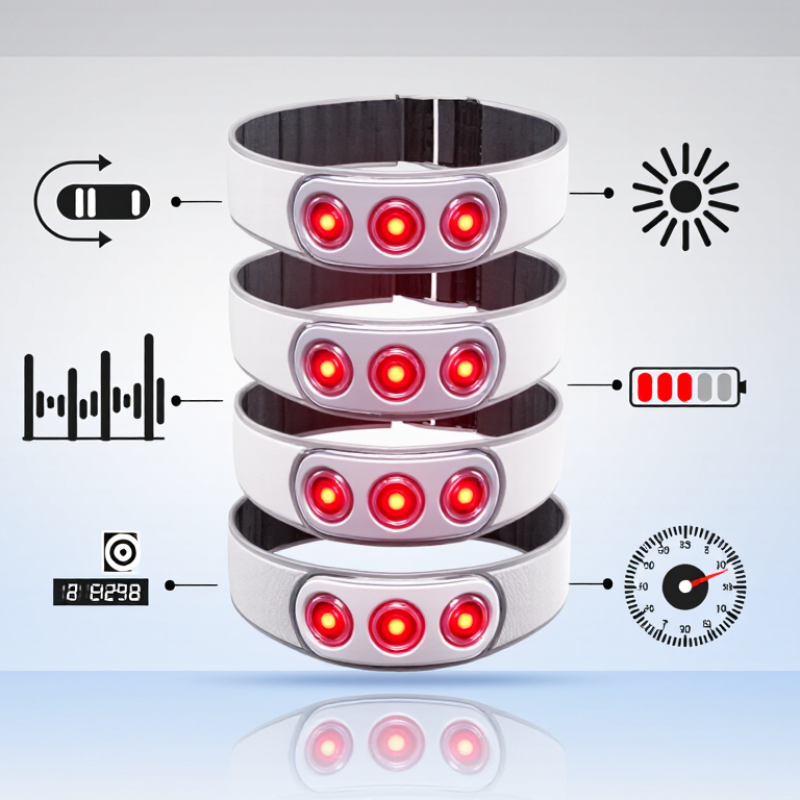
| Treatment Coverage | Belts commonly cover a focused area such as the lower back, abdomen, shoulder, knee, or limb. | Usable treatment area, LED spacing, and active-light coverage are clearly measured rather than estimated from belt size. | Large physical dimensions do not necessarily mean that the entire surface emits therapeutic light. | Coverage diagram, LED layout, active-area dimensions, and photographs of the illuminated surface. | High |
| LED Density and Uniformity | Specifications vary widely; uniformity is more meaningful than LED count alone. | Even light distribution across the active treatment zone, with measured minimum-to-maximum output data. | Hot spots and underpowered areas can create inconsistent exposure across the body. | Irradiance heat map, LED count by wavelength, spacing diagram, and batch inspection criteria. | High |
| Pulse and Continuous Modes | Products may offer continuous output and selectable pulsed modes, often with several preset frequencies. | Mode definitions, pulse frequency, duty cycle, and output changes are documented. | Different modes can change delivered energy and user experience; unclear settings complicate dose control. | Electrical test data and manual listing frequency, duty cycle, and irradiance for every mode. | Medium |
| Temperature Management | Flexible belts can warm during use; temperature depends on LED power, insulation, contact, and ventilation. | Surface temperature remains within a documented comfort and safety limit during the maximum programmed session. | Thermal comfort is important for longer sessions and repeated daily use. | Maximum-temperature test, thermal cut-off specification, over-temperature protection, and user warnings. | High |
| Power System | Options include wired controllers, rechargeable battery packs, USB-C input, or mains adapters. | Battery capacity, charging time, operating time, charging protection, and adapter specifications are stated. | Reliable power delivery prevents interruptions and reduces overheating or charging risks. | Battery datasheet, charger certification, cycle test, operating-time test, and replacement procedure. | High |
| Fit and Adjustability | Elastic straps, hook-and-loop closures, and adjustable panels are common construction methods. | Published fit range, strap strength, ergonomic testing, and stable skin-to-device contact. | Distance from the LEDs to the skin directly affects irradiance and treatment consistency. | Dimensional drawing, fit samples, strap-cycle testing, and user comfort evaluation. | High |
| Materials and Skin Contact | Common materials include polyester, neoprene, silicone, polyurethane, and synthetic leather. | Skin-contact materials are tested for irritation, restricted substances, odor, and durability. | Belts are worn against the body, sometimes repeatedly and for extended periods. | Material composition, REACH or RoHS documentation where applicable, biocompatibility testing, and care instructions. | High |
| Cleaning and Sweat Resistance | Most flexible belts require surface cleaning and are not designed for immersion. | Clearly defined cleaning method, splash-resistance level if claimed, and sealed electronics. | Moisture and sweat can affect hygiene, electrical reliability, and product lifespan. | Ingress-protection test if an IP rating is claimed, cleaning validation, and care-label instructions. | Medium |
| Electrical and EMC Safety | Requirements depend on the sales market and whether the product is classified as medical equipment. | Completed electrical-safety and electromagnetic-compatibility testing for the intended markets. | Testing helps reduce shock, overheating, malfunction, and interference risks. | Applicable IEC/EN test reports, EMC report, adapter certification, risk-management file, and declaration of conformity. | High |
| Regulatory Positioning | Wellness products and medical devices follow different regulatory pathways and advertising rules. | Supplier clearly identifies intended use, product classification, market authorization, and permitted claims. | Marketing claims must match the regulatory status in each destination market. | Technical file summary, registration or clearance details where applicable, labeling, and approved claims list. | High |
| Quality Management System | ISO 9001 is common; ISO 13485 is relevant when manufacturing medical devices under applicable requirements. | Current certificate covers the correct legal entity, factory location, product scope, and certificate validity period. | A certified quality system supports traceability, corrective action, and controlled production processes. | Certificate verification, audit scope, incoming-inspection procedure, CAPA records, and lot-traceability example. | High |
| Production Capacity | Capacity varies by automation, assembly layout, testing stations, and seasonal demand. | Supplier can provide realistic monthly capacity, peak-season capacity, and a documented scale-up plan. | Capacity affects continuity of supply and the ability to handle repeat orders. | Factory audit, production-line photographs, equipment list, capacity calculation, and recent delivery records. | High |
| Minimum Order Quantity | MOQ depends on stock availability, packaging customization, firmware changes, and private-label requirements. | Separate MOQs are provided for standard products, custom colors, packaging, electrical changes, and new tooling. | Transparent MOQs help buyers estimate launch costs and inventory exposure. | Written quotation with tiered pricing, tooling fees, sample policy, and cancellation terms. | Medium |
| Development and Sample Lead Time | Standard samples may take several business days; customized samples usually require additional engineering and testing time. | Supplier provides a stage-by-stage schedule covering design confirmation, sample approval, testing, and mass production. | Predictable development timing supports a controlled 2026 product launch. | Development timeline, sample approval form, engineering-change process, and production schedule. | Medium |
| Warranty and After-Sales Support | Warranty periods vary by supplier and market; one year is a common baseline for consumer electronics. | Written warranty, repair or replacement process, spare-parts policy, and response-time commitment. | Belts contain flexible wiring, batteries, controllers, and closures that may require support after sale. | Warranty certificate, failure-rate target, RMA process, spare-parts list, and service-level agreement. | High |
| Packaging and Documentation | Typical documentation includes user instructions, charging information, warnings, cleaning guidance, and labeling. | Packaging is adapted to destination-market language, recycling rules, labeling requirements, and transport conditions. | Complete documentation reduces misuse, returns, and customs or compliance delays. | Artwork files, multilingual manual, carton specifications, barcode format, and packaging drop-test results. | Medium |
| Cost Structure | Quoted unit price is influenced by wavelength mix, LED density, battery, controller, materials, testing, packaging, and order volume. | Supplier provides a transparent landed-cost model rather than only a unit price. | A low unit price can conceal tooling, certification, packaging, freight, or replacement costs. | Itemized quotation, tooling schedule, testing charges, packaging cost, Incoterms, and payment terms. | High |
| Supply-Chain Traceability | Traceability may cover LED lots, batteries, controllers, finished units, and shipment batches. | Each production batch can be linked to component suppliers, inspection records, and shipment documentation. | Traceability supports recalls, root-cause analysis, and consistent quality across repeat orders. | Lot-code example, bill of materials, incoming-inspection records, final-test report, and retention policy. | High |