| Looped String Figures | A continuous string loop is transferred and reshaped between the fingers to create recognizable patterns. | Soft cotton string; optional wooden finger guides or handles. | Fine-motor control, bilateral coordination, sequencing, and concentration. | Pattern copying, verbal instruction, cultural storytelling, and hand-eye coordination practice. | Beginner to intermediate | Use a smooth, unfrayed string and supervise younger children to prevent wrapping around fingers or wrists. |
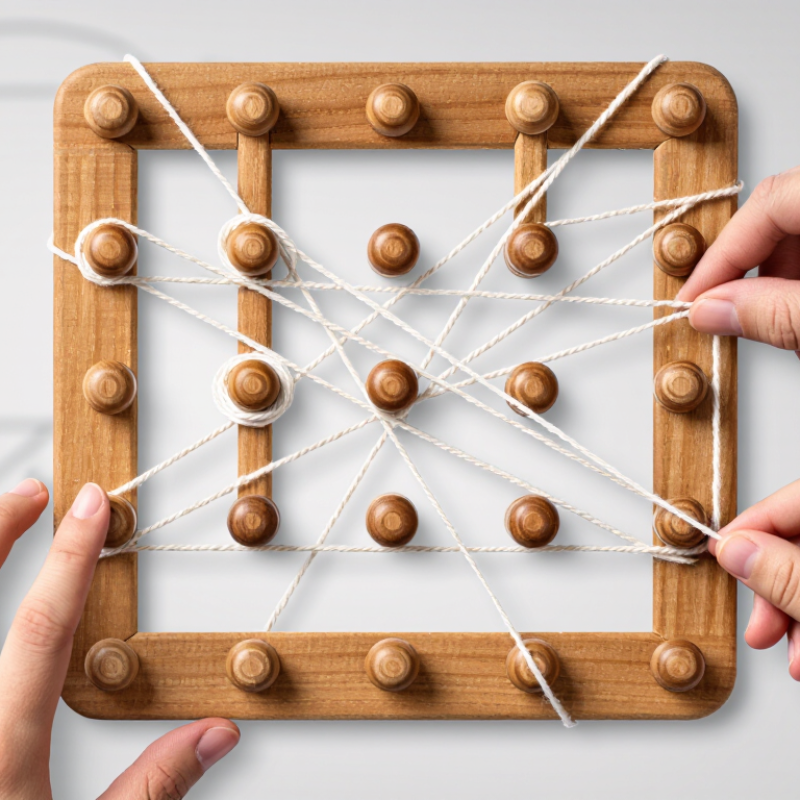
| Wooden Peg-and-String Board | Players stretch or weave string around fixed wooden pegs to reproduce shapes, paths, or geometric designs. | Wooden board, rounded pegs, elastic or cotton string, and pattern cards. | Spatial reasoning, visual tracking, planning, and controlled hand movements. | Geometry, symmetry, angles, coordinates, and design-based problem solving. | Beginner to advanced | Pegs should be securely fitted, rounded, and free from splinters; avoid overly tight string tension. |
| String-and-Bead Threading Game | Players thread or move large beads along a cord, often following a color, size, or sequence rule. | Wooden beads with large holes, a thick cord, and a wooden stopper or base. | Pincer grasp, visual discrimination, memory, and sequencing. | Color recognition, counting, sorting, repeating patterns, and early mathematical thinking. | Entry level | Small beads may present a choking hazard; use only age-appropriate pieces and supervise young children. |
| Wooden String Maze | A ball, ring, or slider is guided through a cord-defined route without leaving the intended path. | Wooden frame, attached string or cord, and a wooden or metal movable piece. | Steady hand control, visual-motor integration, patience, and route planning. | Maze solving, directional language, sequencing, and performance monitoring. | Beginner to intermediate | Check that cords are firmly attached and that the frame has no sharp corners or loose hardware. |
| String Art on a Wooden Board | String is wrapped between nails or pegs to form lines, polygons, curves, or layered pictures. | Wooden board, blunt pegs or supervised nail points, and colored string. | Planning, precision, pattern recognition, creativity, and sustained attention. | Line geometry, symmetry, coordinate planning, visual arts, and project management. | Intermediate | For children, use rounded pegs or have an adult prepare the board; supervise all pointed components. |
| Cooperative String Challenge | Two or more players coordinate tension and movement to carry, balance, or position an object using connected strings. | Wooden platform or ball, several cords, and a clear playing surface. | Communication, timing, teamwork, force control, and problem solving. | Collaborative learning, role assignment, cause-and-effect reasoning, and reflection. | Intermediate to advanced | Keep cords at waist level or below, maintain a clear floor area, and stop if the string becomes tangled. |
| Pattern-Matching String Puzzle | Players arrange strings across a wooden grid to match a target image or satisfy a set of positional rules. | Wooden grid, pegs, removable cords, and challenge cards. | Working memory, deductive reasoning, spatial visualization, and error correction. | Logic, transformations, symmetry, constraints, and independent learning. | Intermediate to advanced | Use durable, non-splintering wood and cords that can be removed easily without excessive force. |